
Bloomfield Resident Lookup Record Coverage
Bloomfield has no single public resident database. Each official record answers only part of a one-person question. Essex County PROS is the property route. NJ Courts is the name-and-case route. The state voter-status service is a registration check, not a roster. Vital records have strict access rules, and older identity clues live in library and archive collections. Use a record's actual purpose as the limit of the conclusion drawn from it.
| Record | What It Confirms | Where | Access |
|---|---|---|---|
| Tax and assessment card | Tax owner, situs, mailing clue, and parcel identity | Essex County PROS and Bloomfield Tax Assessor | Public portal; owner is not automatically an occupant |
| Recorded deed | Named parties, recorded transfer, and legal description | Essex Register PRESS and Hall of Records | Public index; older books and image coverage vary |
| Voter status or list | Registration status, or statutory list fields when properly requested | New Jersey voter status service and Essex election office | Status portal has a live-field gap; list use is restricted |
| Court case index | Party, venue, docket, caption, initiation date, and event-level data | NJ Courts, Bloomfield Municipal Court, or Superior Court clerk | Public index; sealed, juvenile, and expunged material is withheld |
| Vital record or genealogy search | Eligible birth, death, marriage, or civil-union event evidence | Bloomfield Vital Statistics, NJDOH, and State Archives | No general public online name database; eligibility controls copies |
| Historical directory or yearbook | Dated address, household, school-year, or obituary clue | Bloomfield Public Library and linked archives | Historical access; volume and index gaps remain |
Begin with PROS when an address or parcel is known. Begin with the court index when the question is about a named case. Use the library's historical shelf when the person or address belongs to an earlier period. A recorded deed can test a property connection, but it does not establish that every person tied to a name lived at that address.
Verifying a Bloomfield Resident's Record
Same-name matches are common enough to require a deliberate check. Normalize the full name first: try a middle initial, complete middle name, suffix, married or prior surname where lawfully available, and ordinary spelling variants. Then collect independent anchors. A name and street is weak. A name, middle initial, address clue, Essex venue, and compatible date is much stronger. Keep a simple source-and-date log so a later result does not silently replace the first one.
- Search Essex County PROS by owner, address, SBL, Street Finder, or municipality. Save the displayed situs separately from the tax mailing address.
- Use the parcel identity and the Essex Register's PRESS index to test a deed party or legal description. Treat a nonlocal tax mailing address as a clue, not proof of where a person lives.
- Run the person name and its variants through NJ Courts, then compare the venue, docket, caption, and case initiation date with the anchors already collected.
- Use voter status only as a dated match signal. A failed form result can reflect a protected address, a mismatch, or an unrendered field, and inactive status is not proof of a move.
- For older identity questions, test the result against a directory, census, yearbook, obituary, cemetery record, or public probate record. Preserve the collection year and printed page.
A result that fails one of those tests should remain a possibility, not a conclusion. A living person's sensitive details do not need to be repeated to verify a source trail. For a historical person, the useful citation is the keeper, year, collection, page, and image location.
- Docket
- The court's case identifier. It ties a party-name result to the court record and should be copied exactly.
- Index versus image
- An index reports that a record entry exists; an image is the underlying filed or scanned item. A docket row may list a document without making its image public.
- Certified copy
- A custodian-issued copy used where the agency's rules require formal certification, identification, relationship proof, or a fee.
Bloomfield Resident Lookup Through NJ Courts
NJ Courts Find a Case links statewide civil, criminal, judgment-lien, Tax Court, Supreme Court, municipal, and related routes. In party-name mode, the public case-jacket guide requires a last name and first name, with middle initial optional. It also offers docket-number and judgment search modes. For a name search, the guide says two characters or fewer match exactly, while three or more allow broader matching. Narrow a result with the venue and known date before treating it as an Essex match.
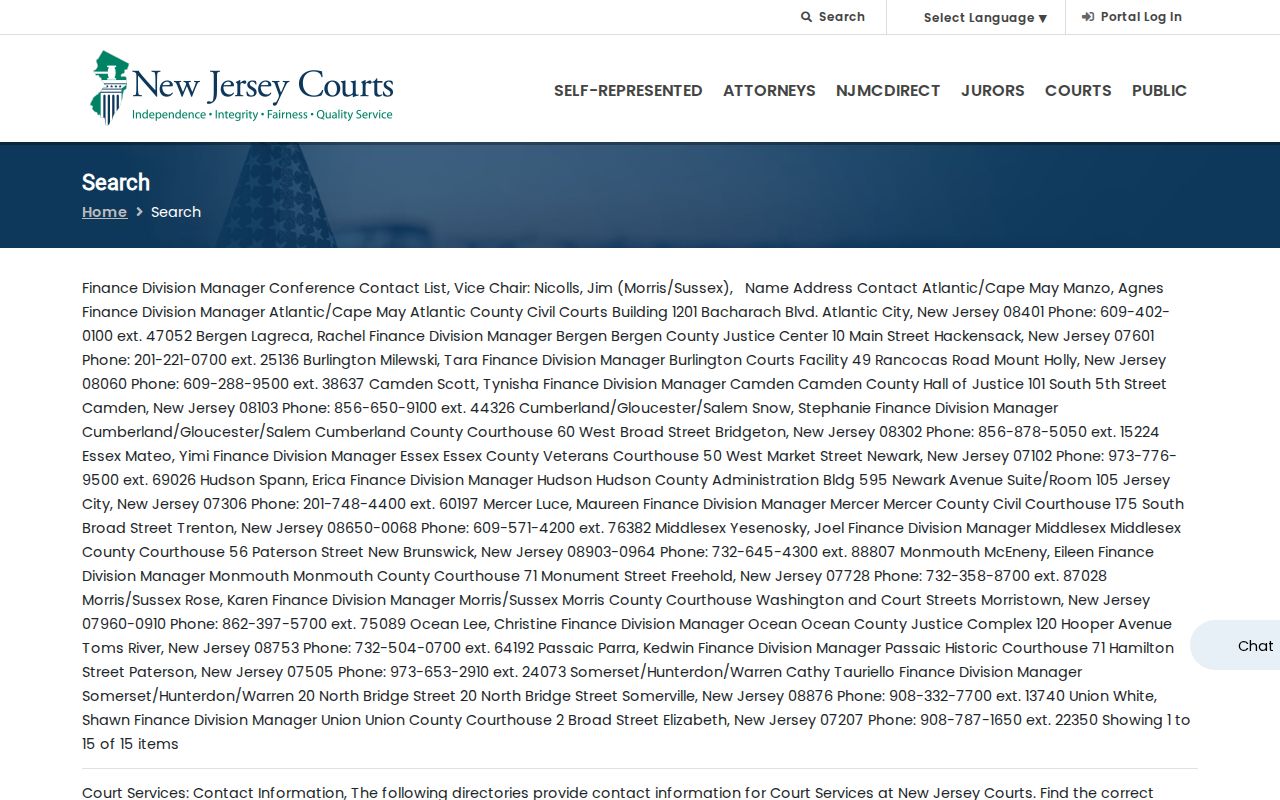
The court landing page is only the entry point. Bloomfield matters may also be routed through Bloomfield Municipal Court or Essex Vicinage Superior Court in Newark. The Essex Superior Court criminal-records and expungement office is at Veterans Courthouse, 50 W Market Street, Newark. The County Clerk directs court matters to the Superior Court Clerk. When an exact local docket is known, the court counter or official copy route is a better fallback than an open-ended name request.
A public result normally carries the party name, venue, docket number, case caption, and case initiation date. A clicked docket can show a list of filings, orders, proceedings, dispositions, parties, status, and attorneys. A filed-document row is not necessarily a public document image or its text. Sealed, juvenile, adoption, protected family, and expunged material have separate restrictions.
- Party name, shown as indexed for an individual or business.
- Venue, which helps connect a statewide name result to Essex.
- Docket number, the specific case key.
- Case caption, as displayed in the public result.
- Case initiation date, showing when the case began in the system.
- Case type or status, when the public jacket displays it.
- Filed-document and proceeding rows, which may not include a public image.
Note: Public individual searches are free, while advanced Electronic Access has separate time charges and restrictions on downloading or scraping.
Bloomfield Voter Status Checks
New Jersey's voter registration status service is the official online status route. The accessible research render did not expose its live form labels, required fields, matching rules, or result fields. That gap should be respected. Do not assume it accepts a full address, a date of birth, or a county field unless the live form confirms it. A status result can be one date-specific confirmation, not a complete account of a person or a household.
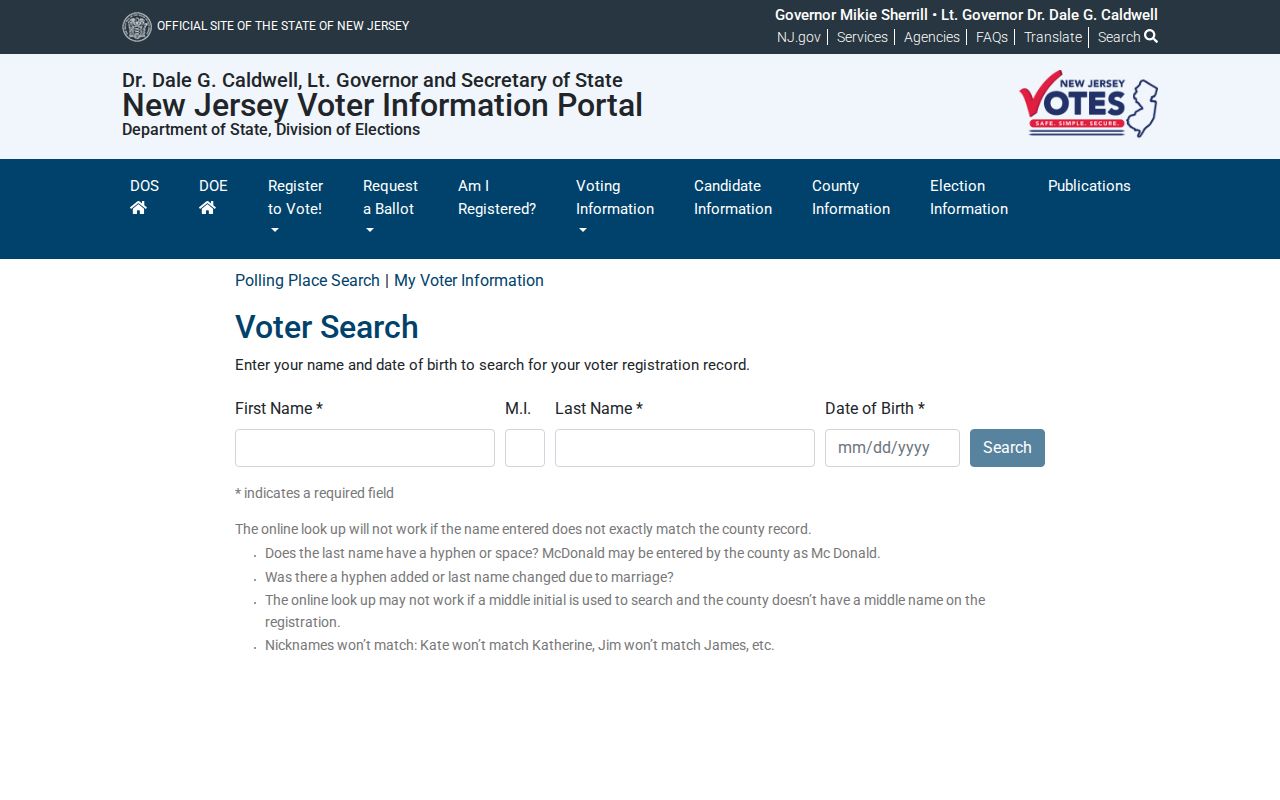
N.J.S.A. 19:31-18 describes statewide voter-list fields including name, address, date of birth, party affiliation, and voting history, subject to protected-person exclusions. It does not disclose signatures or ballot choices. N.J.S.A. 19:31-18.1 controls copies, price, and use. The county-level delivery format, current request form, and exact electronic layout were not verified, so a requester should ask the Essex election office for the current statutory product and permitted-use certification.
For a counter or submission question, Essex County voter services is reached through the County Clerk at 495 Martin Luther King Justice Building, Newark, 973-621-4920, info@clerk.essexcountynj.org. The County's public guidance gives the registration route, while the State Archives and the library are more appropriate for historical register questions. Protected voters and Address Confidentiality Program participants may lawfully have omitted or substitute address data.
Bloomfield Vital Record Limits
New Jersey's current vital-record route makes clear that vital records are not public records and cannot be searched as a general online database. Bloomfield Vital Statistics, Room 111 at 1 Municipal Plaza, issues local copies for events in Bloomfield and lists 973-680-4025 and 973-680-4029. NJDOH holds births from 1925 forward, marriages and deaths from 1951 forward, and later domestic-partnership and civil-union series. The State Archives holds births through 1924 and marriages and deaths through 1950.
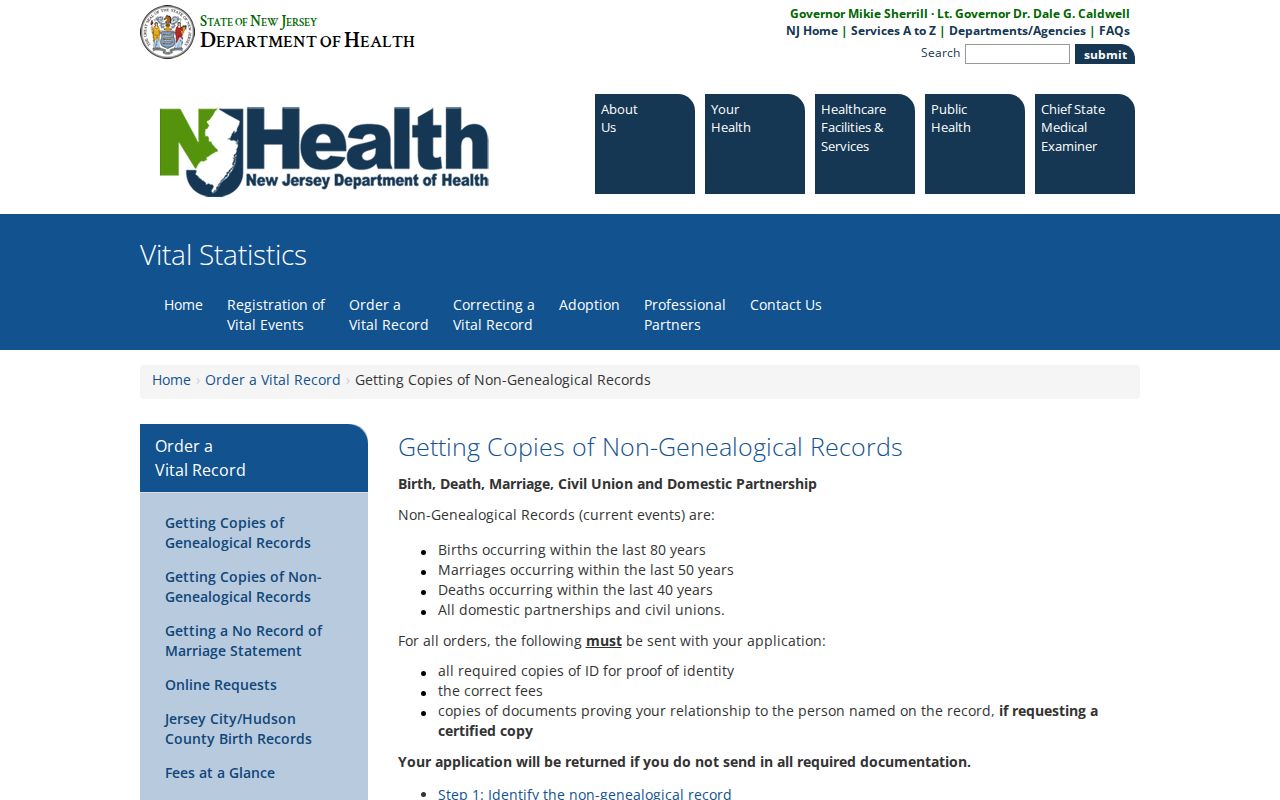
For current non-genealogical access, the state windows are births less than 80 years old, marriages less than 50 years old, deaths less than 40 years old, plus all domestic partnerships and civil unions. Certified copies require identification, a fee, and proof of qualifying relationship. An informational certification may not require relationship proof but is not a legal identity document. A person who does not qualify needs a court order; a subpoena alone is not enough under the state guidance.
Older genealogy access is separate: births older than 80 years through 1925, marriages older than 50 years through 1951, and deaths older than 40 years through 1951 for deceased people. The state genealogy application asks for the full name, city or county, and year, with other facts serving as optional search clues. Use the local registrar, NJDOH mail or walk-in route, or State Archives according to the record period and eligibility. Neither the local counter nor a state form turns a restricted record into a name-search result.
Bloomfield Records Fallbacks and OPRA
When an online path ends, use the keeper that holds the record. For a parcel question, Bloomfield Tax Assessor is at 1 Municipal Plaza, Room 108, 973-680-4021. For a recorded document, the Essex Register's public room and older books at the Hall of Records are the fallback when online coverage stops. PRESS displays a 10/01/1996 public-search start, while the Register homepage describes remote public internet property transactions from May 1, 2001 and computerized indexing from December 1988. The different dates should be recorded, not silently reconciled.
Bloomfield's OPRA request form is the municipal route for an existing Township record that is not posted online. Under the New Jersey Open Public Records Act, N.J.S.A. 47:1A-1 et seq., a written request goes to the correct custodian and normally receives a response within seven business days when the record is available. Ask for a defined record series, exact address or name when relevant, and a date range. OPRA does not require an office to create a new investigation or compile a new person file.
The full fallback chain can include the municipal counter, the court clerk's copy procedure, NJDOH, the Register, the library reference desk, or the State Archives. Bloomfield Public Library's local archives can help with directories, yearbooks, newspapers, census links, and historical context. Staff research is subject to time and possible Special Collections fees. These channels preserve the distinction between a missing portal result and a missing record.
Bloomfield Records for Past Identity
A former classmate question is often better served by the library than by a current portal. Bloomfield High School yearbooks run from 1908 through 2018, although the collection is incomplete. Pre-1977 volumes are scanned through Archive.org, and later volumes are available at the library because of copyright. A yearbook name should be checked against an obituary, local newspaper, directory, or census result before being tied to a later record.
For an heir or estate question, start with a probate or estate docket and request the precise public file rather than asking a clerk to identify an heir. A named representative or heir reference can then be tested with a recorded deed and obituary. New Jersey adoption records are restricted; the research did not verify a current official adoption-registry page or eligibility form, so there is no public birth-parent search path to promise.
State business records and professional verification can confirm a public entity affiliation or a named license. The NJ Division of Revenue route can show business status, registered agent, addresses, filing dates, officers, and annual-report information. The Consumer Affairs verification route checks named licenses. Neither is proof of a private residence. For a historical person, the Bloomfield city directory collections provide the better dated address layer.
Bloomfield Record Privacy Boundaries
Missing information can be a lawful protection. The New Jersey Address Confidentiality Program provides a legal substitute address for eligible survivors and certain health-care-related applicants, while Daniel's Law can remove eligible covered persons' home addresses from government internet display. Neither program guarantees that an already-public record disappears everywhere. A tax correction, court correction, vital amendment, protected-address request, and private controller opt-out are different processes handled by different custodians.
New Jersey motor-vehicle records are separately limited under the DPPA. Voter-list copies have their own protected-person and no-solicitation rules. Court records can be sealed or expunged. These boundaries mean that a failed lookup should stay qualified: it may reflect a spelling variation, source cutoff, access restriction, or a person who was never the subject of that record.
Lawful use. Use Bloomfield record links for personal, lawful research and verification. Do not use public information to stalk, harass, intimidate, or defeat an address-protection program; New Jersey law addresses stalking and harassment at N.J.S.A. 2C:12-10 and N.J.S.A. 2C:33-4.
Note: When a record appears wrong, ask the original custodian for its correction process and keep the request date with any response.