
Bloomfield City Directory Shelves
Bloomfield Public Library is the main local shelf for historical directory volumes. Its collection is described as an in-process run from 1870 through 1970, made mostly from Bloomfield sections within the Orange Directory. Print copies are held by the library, and much of the material is linked through its Internet Archive collection. That distinction matters: a scan with Bloomfield names is often part of an Orange publication, rather than a separately issued Bloomfield volume. Search by year, series, section, and page when taking notes.
The directory material sits beside useful companion sources. The library links to Montclair History Online for additional directory coverage, while its local resources include federal census tools, newspapers, obituaries, and cemetery material. The State Archives preserves a much earlier layer of Bloomfield records. None of these sets is a complete annual list, but their different dates make a household trail easier to test.
| Collection | Years | Where Held | Access |
|---|---|---|---|
| Bloomfield sections of the Orange Directory | 1870-1970, in process | Bloomfield Public Library print collection and Internet Archive links | Print access and online scans; exact volume run varies |
| 1870 Orange Directory | 1870 | Internet Archive item linked through the library | Public PDF and OCR derivatives; 95-page scan |
| Bloomfield High School yearbooks | 1908-2018, incomplete | Bloomfield Public Library | Pre-1977 scans at Archive.org; later copies at the library |
| Bloomfield obituary index | About 1973-2016, incomplete segments | Library Bios & Obits and newspaper resources | Index and archive access; missing names remain possible |
| Bloomfield ledgers and day books | 1812-1899 | New Jersey State Archives, finding aid MBL00001 | Nine archival volumes; not a directory series |
Note: A missing year or missing name is a collection limit, not proof that a household was absent from Bloomfield.
Bloomfield Directory Series and Orange Publishing
The publisher question is a practical search problem. The inspected 1870 item identifies itself as an Orange Directory, for 1870, with street and business directories, and credits Fitzgerald & Dillon. Its OCR shows a 95-page scan. Bloomfield material must therefore be read in the context of the Orange publication. Calling it a standalone Bloomfield publication would hide the best search term and misstate what the library assembled.
The same volume supports two ways of working. Begin in an alphabetical section when the name is known. Then use the street section when the address is known or when a name needs a nearby-location check. The volume advertises a business directory as well, which can help distinguish similar historical names, but a line in that section records a period publication entry, not a current personal fact. Save the printed page number and the scan link with each transcription.
Bloomfield Directory Access at the Library
Bloomfield Public Library's Genealogy and Local Archives page describes the research room and Special Collections access at 90 Broad Street. Reference and most Special Collections are upstairs. Digitization is still in progress, and staff may undertake outside-resident research as time allows; any fee may be set by the Special Collections Librarian. The library lists 973-566-6200 and reference@bloomfield.bccls.org for an access question. Ancestry Library Edition is available at the library, HeritageQuest can be reached remotely with a Bloomfield card, and some FamilySearch material has affiliate-level access limits.
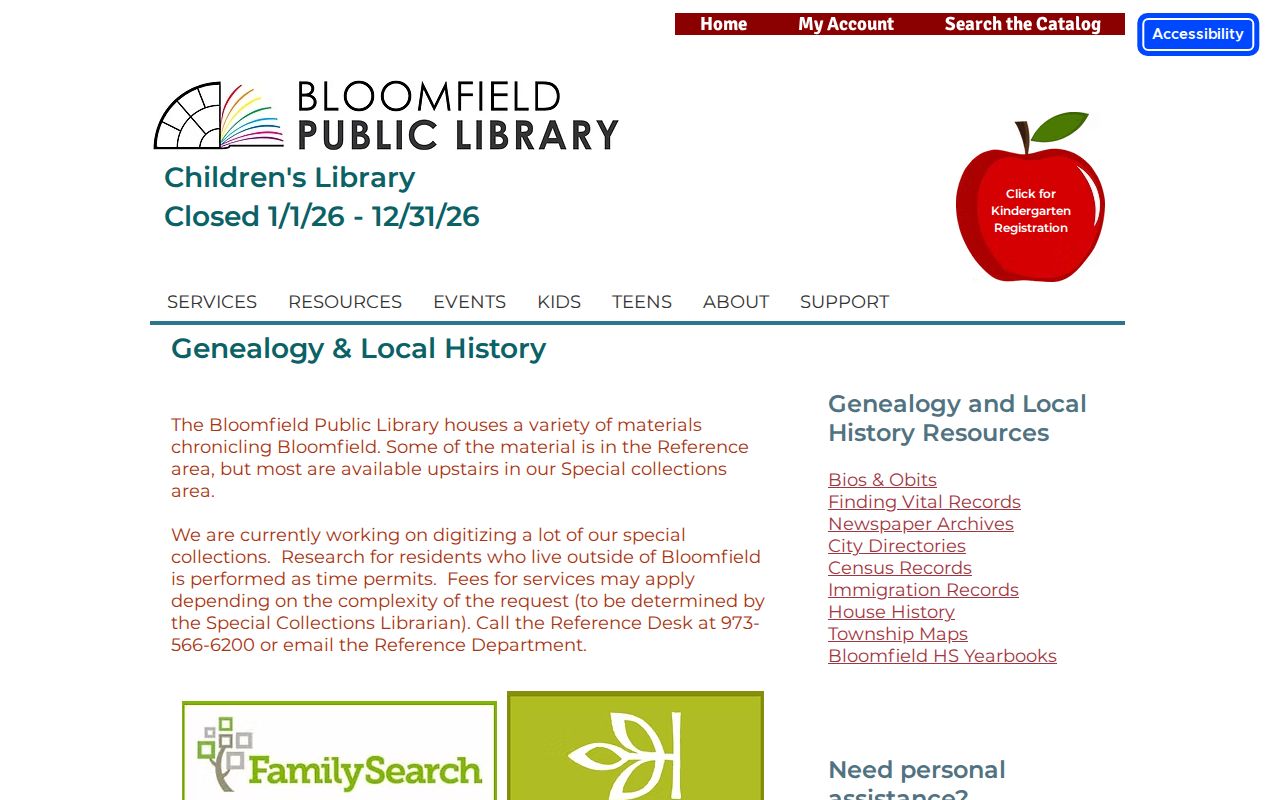
Bring the directory year, publisher or series, section, and page when asking for help. That small record of the source lets staff find the right scan or print volume without treating an OCR match as final. The library's city-directory page also warns that the Children's Library is closed during 2026 and advises checking Special Collections and digitization access before a visit.
The library's city-directories page is the direct route to its 1870-1970 collection note and its digitized links. Print copies remain important where an online scan is incomplete, an OCR search fails, or a street section is hard to read. A researcher outside Bloomfield can ask about staff time and any applicable research fee, but should not assume a remote request will be filled.
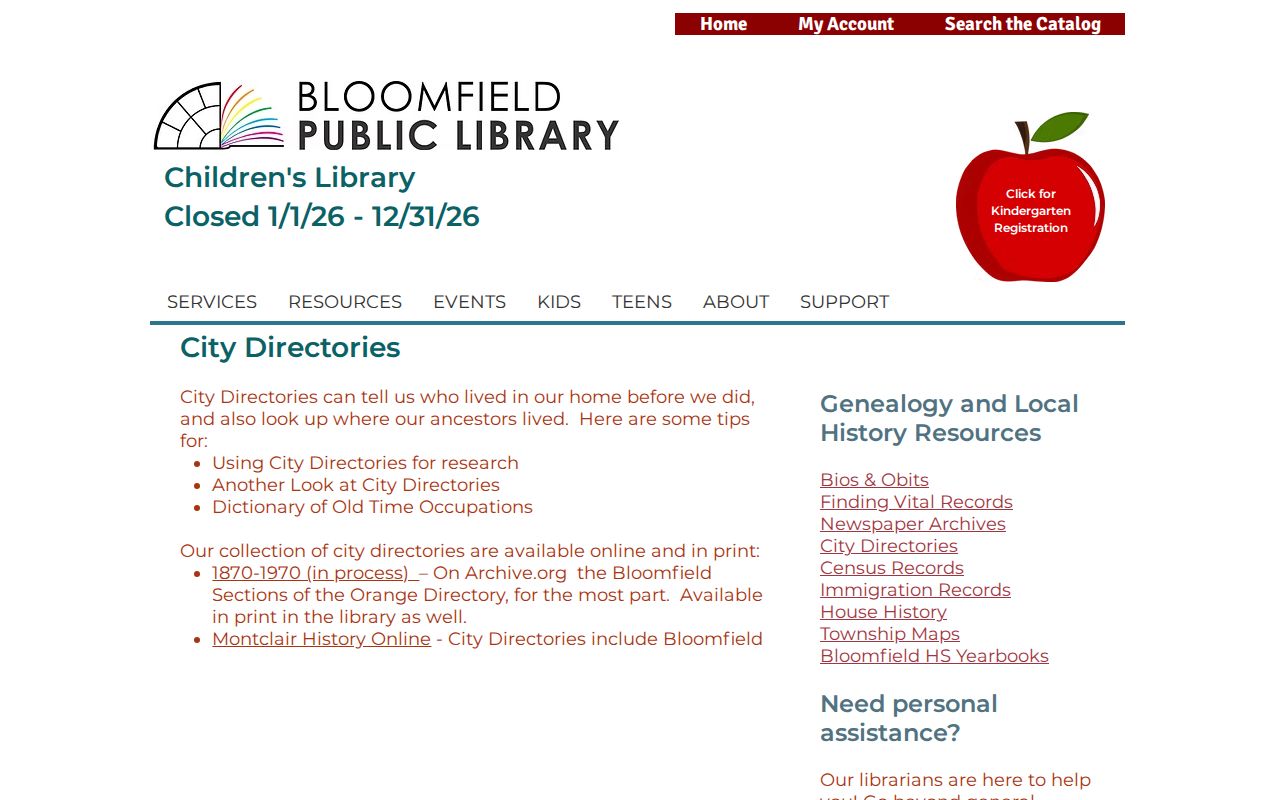
The collection description is also a reminder to check a wider Orange series when a Bloomfield search returns nothing. The page links the local material to Internet Archive rather than presenting it as a single name-search database.
Reading a Bloomfield Directory Entry
An old line has to be read as printed. In the inspected 1870 Orange Directory, names appear surname first. A line can combine a person's name, an occupation, an address, a business or affiliation clue, and a home or boarding mark. Some details appear in different sections of the same volume. A parenthetical phrase, a Mrs. notation, or a work location can help separate two people with the same name, but it is not a substitute for a source dated closer to the event being researched.
| Printed name | Read the surname-first form and preserve initials exactly as they appear. |
|---|---|
| Occupation or business | A period clue that may distinguish same-name people, not evidence of a current role. |
| Address line | Street, number, cross street, or repeated address notation such as h do. |
| Household notation | Mrs., a parenthetical clue, or a widow-style notation can point to a household question. |
| Boarding clue | In the 1870 key, b means boards; it is not a modern residence category. |
| Printed page and section | Keep both with the image or PDF location so another reader can verify the transcription. |
The 1870 key defines such terms as ab for above, av for avenue, c for corner, h for house, n for near, and R R for railroad. The exact key changes by publisher and year. Photograph or transcribe it before expanding an abbreviation from memory.
- Criss-cross directory
- An address-first or street-order arrangement that can be checked after a name entry, when a volume supplies one.
- Householder index
- An arrangement centered on the listed household name rather than every person who may have been present at an address.
- Abbreviation key
- The printed legend that defines the marks and short forms used in that particular directory volume.
Trace Bloomfield Directories With Census
A household trail is strongest when each source has a clear date. Directories record a publication year. Census schedules record a fixed enumeration date. Deeds may be recorded after they were signed. Keeping those dates separate can explain an apparent conflict. The library's census resources and enumeration maps help connect a directory street line to the right federal census setting. The 1950 census is accessible under the 72-year release rule; later federal schedules remain subject to their release timing.
- Start with a surname or address from a family paper, deed, obituary, or parcel record, and record the exact form of it.
- Check the alphabetical section for the surname and the street section for the address, including alternate street names and old number forms.
- Write down each year's printed spelling, address, household notation, occupation clue, page, and collection link without merging similar names.
- Pair the directory observations with the 1900, 1910, 1920, 1930, 1940, or 1950 census as appropriate, using the street and enumeration map to test the household.
- Use an obituary, cemetery record, marriage record, probate file, or deed to test whether a disappearance reflects a move, death, marriage, or directory gap.
Ownership and occupancy are different questions. A deed or tax card can establish a recorded transaction or a current tax owner. It does not list every historical occupant. For a present address question, the modern address-record path belongs on the Bloomfield street directory; the historical directory shelf is best used to date the older household trail.
Bloomfield Directory Gaps and Companion Sources
The library's Bios & Obits material provides useful end points, but it is not complete. Its Independent Press and Bloomfield Life index has volunteer-maintained segments roughly covering 1973-2005 and 2005-2015, plus an incomplete 2016 segment that ended around September. The library recommends checking a newspaper one to two weeks after a death. A missing index hit therefore does not settle whether a person died, moved, or simply was not indexed.
Bloomfield High School yearbooks cover 1908-2018, though the run is incomplete. Pre-1977 books have Archive.org scans; later copies remain at the library because of copyright. These can support a school-year identity question when paired with a directory, newspaper, or obituary. The library also provides current and back issues of the Newark Star-Ledger through its services, and its Independent Press archive starts in 2015. Historical Society papers, maps, deeds, letters, and clippings can add a local setting when the directory line alone is thin.
Bloomfield Directory History in Context
Bloomfield's record history is a sequence of keepers rather than one continuous database. The State Archives finding aid MBL00001 identifies nine Bloomfield ledgers and day books from 1812-1899. They include a financial record book for 1812-1845, a ledger for 1871-1898, and day books for 1871-1894 and 1893-1899. Those volumes are an early municipal record layer, not directory volumes, but they make it possible to set a directory clue beside a contemporary local record.
- 1812: municipal establishment and the beginning of the earliest surviving ledger period identified by the State Archives.
- 1870: the inspected Orange Directory issue supplies alphabetical, street, and business-directory context for Bloomfield material.
- 1870-1970: the library describes its in-process directory collection, largely Bloomfield sections of the Orange series.
- 1908-2018: the library's incomplete Bloomfield High School yearbook run extends the identity trail into later decades.
Historical geography also needs a date. The Historical Society's 1865 map predates later separations involving Montclair, Glen Ridge, Belleville, and Nutley. A nineteenth-century reference to Bloomfield can refer to a different jurisdictional setting than a modern map. Keep the printed town name, map year, and source keeper together.
Note: No verified courthouse fire or local records-destruction event was located in the official research, so directory gaps should not be assigned a cause.
Bloomfield Directory Clues at the Historical Society
The Historical Society of Bloomfield offers another local-history handoff for maps, newspapers, postcards, letters, deeds, documents, photographs, books, and clippings. Its collection can supply the setting around an address or a family name found in a directory. The Society was founded around the 1962 sesquicentennial and incorporated in 1966. Its museum has been temporarily closed during restoration of the Children's Library, so confirm current appointment hours before visiting. The published contact is 973-743-8844 or info@hsob.org.
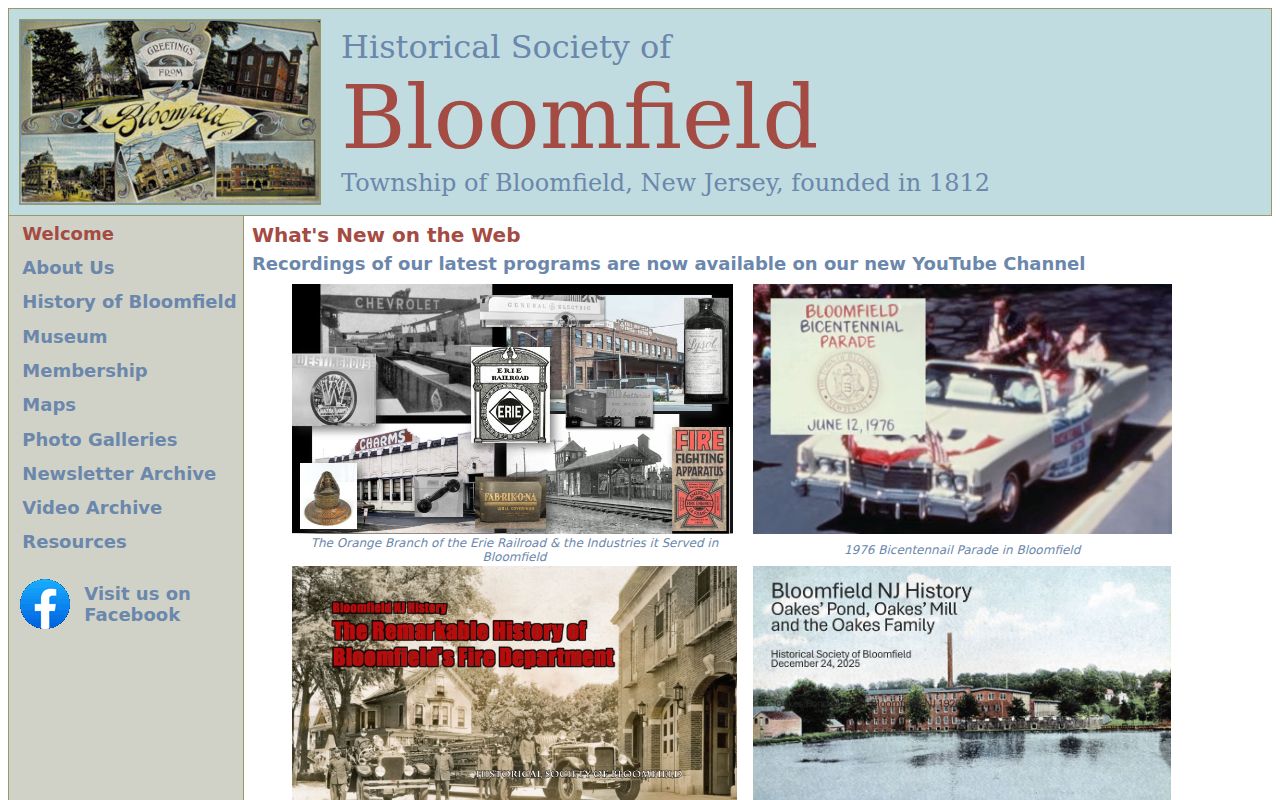
The Society's materials should be cited by item and date, not blended into an unsourced personal profile. A map, newspaper clipping, or directory scan each records a different thing. That careful separation makes a family-history result repeatable and protects against treating local color as proof about a person.