
Sources Behind Bloomfield Previous Residents
Bloomfield address history has several time layers. Essex County PROS supplies the current parcel key, while the Essex County Register connects recorded parties to a deed placement. The Bloomfield Public Library house-history route then joins deeds to directories, census work, newspapers, maps, and municipal materials. None of these is a full list of past residents, but together they make a repeatable address trail.
| Source | Years It Covers | Where Held | What It Shows |
|---|---|---|---|
| Essex deed and mortgage books | Back to 1637 | Hall of Records public room | Recorded ownership and legal transaction clues |
| Computerized Register index | December 1988 onward | Register and PRESS systems | Later indexed recorded documents |
| PRESS public search | From 10/01/1996 on its interface | Online | Party, document, date, and placement handoffs |
| Bloomfield and Orange directories | 1870-1970, in process | Library print and Internet Archive | Historical address and household clues |
| Federal census schedules | 1790-1950 released schedules | Library and genealogy repositories | Household evidence at a census date |
| Bloomfield ledgers and day books | 1812-1899, nine volumes | New Jersey State Archives | Early municipal-era names, not a resident roll |
Start with PROS when the modern address is known. Start at the library when the question concerns a household in the directory era. A deed book, directory, or census result answers only the part of the question that its date supports.
Bloomfield Parcel Records First
Enter the exact situs address in PROS and save the owner name, parcel or SBL identifier, assessment-year label, and any sale clue. Situs means the physical parcel location. The tax mailing address is only the address used for correspondence and may be outside Bloomfield, so it is not proof that someone lived at the property. A tax map can confirm the block and lot before the recorded deed search begins.
The parcel identifier is more durable than street text. Old deeds may use a lot, block, subdivision, or metes-and-bounds description instead of the modern number. If an address has changed or a parcel has split, compare the full displayed SBL and legal description rather than assuming a similar street name is the same place.
Note: A current assessment card is a present tax record, not evidence that every person tied to the parcel lived there.
Bloomfield Recorder Access Milestones
The Essex Register preserves a notably deep records trail. Its Register information says deeds and mortgages reach back to 1637, computerized recording and indexing began in December 1988, and remote public internet property transactions begin May 1, 2001. The PRESS public search screen instead says records are searchable from 10/01/1996. Treat those as distinct milestones, not competing claims about one simple cutoff.
When a result falls near a boundary, confirm the needed year with Register staff. The Hall of Records public room has books, computers, and staff who can demonstrate index and book use, though staff do not conduct a title search. Mortgage cancellations before July 2, 2012 can appear in the index without an electronic image, making the book/page or document number especially useful.
The Register’s public room is in Room 130 at 465 Martin Luther King Jr. Boulevard in Newark. Published public-room hours are Monday through Friday, 8:30-4:30, with the last transaction at 4:15. Call 973-621-4960 or use the Register’s published contact route before a visit, especially when the needed deed may be in an older book.
Bloomfield House-History Method
The library’s house-history sequence is practical because it changes sources as the date moves backward: PROS, Essex Register deeds, older deeds, city directories, census schedules, newspapers, Sanborn maps, permits or blueprints, tax transfers, the Mueller Atlas, images, and local maps. For a municipal record that has no verified online index, use a written request for an existing record by exact address and date range rather than asking an office to investigate a house.
The library’s house-history resource illustrates that sequence. It is a useful reminder to carry the same parcel key and street spelling from one source to the next.
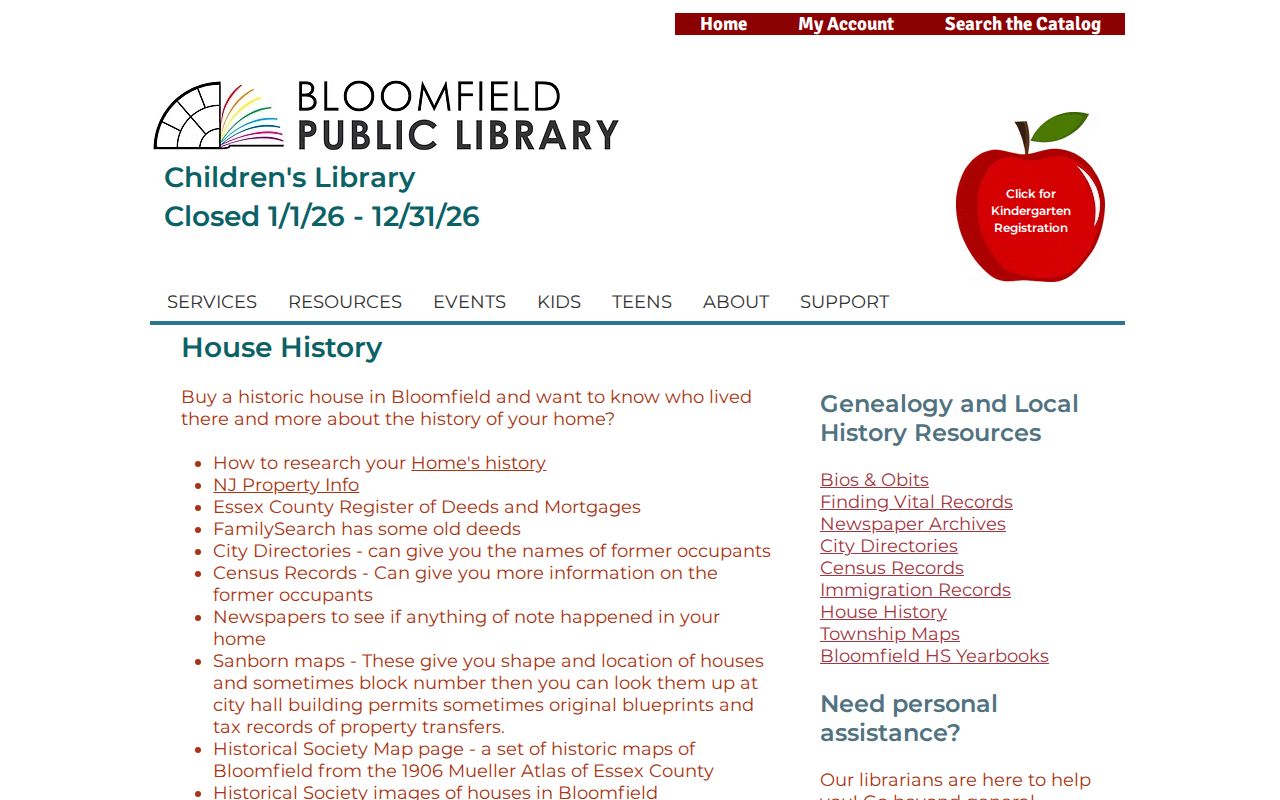
Its research path keeps physical-building evidence separate from a claim about who occupied the address at a particular time.
Bloomfield Previous Residents Through Deeds
For the ownership trail, search the present owner as a grantee in PRESS. A grantee is the party receiving the property, while a grantor is the party transferring it. Capture the purchase deed’s recording date, full legal description, and book/page or document number. Next, take the grantor from that deed and search that person or entity as a grantee in an earlier transaction. Match the municipality and the legal description at each turn.
- Find the exact situs in PROS and record the parcel identifier and current owner.
- Search that owner as grantee in PRESS and identify the purchase deed.
- Copy the deed’s legal description, recording date, and book/page or document number.
- Search the prior grantor as a grantee, checking spouse, estate, trust, and entity spellings where the record requires it.
- Repeat backward until the online boundary, then bring the last placement key to the Hall of Records public room.
That sequence traces title, not every resident. It becomes stronger when date, parties, legal description, and parcel key all point to the same address history.
Bloomfield Deed Record Terms
Recorded-property vocabulary prevents a false match. The same street number can appear in different eras, and an old instrument can omit the number entirely. Preserve the text as the record gives it before translating it to a modern parcel.
- Grantor
- The party that transfers an interest in the recorded deed.
- Grantee
- The party that receives that interest. Searching a grantor as a later grantee is a way to continue backward.
- Chain of title
- The ordered sequence of transfers connecting one recorded owner to an earlier one.
- Legal description
- The parcel description in a deed, such as block and lot, subdivision, or metes and bounds. It is often safer than an old street number.
Use the book/page or document number as the handoff to the public room when an image is unavailable. An index row is a locator, not necessarily the whole document.
Bloomfield Past Household Evidence
Owners are only one layer of who lived here before. The local collection is mostly Bloomfield sections of the Orange Directory, held in print and digitized in part, with a documented span of 1870-1970. Search both the alphabetical and street sections where a volume has them. Record the exact printed spelling, address, abbreviations, and page because the key changes by publisher and year.
Pair a directory observation with a federal census schedule for the closest available census year. Census records show a household at one enumeration date, not an annual trail. Then use the library’s obituary index, newspaper archives, cemetery material, or a probate file to test whether a disappearance suggests a move, death, marriage, or a directory gap. The collections themselves are described more fully in the Bloomfield city directory.
Process: address and directory year → printed household clue → census year and enumeration context → obituary, cemetery, or probate endpoint → deed date check.
Bloomfield Previous Residents in Print
The 1870 Orange Directory sample is a useful warning against reading old abbreviations by guesswork. It has alphabetical, street, and business sections, and uses marks such as h for house and b for boards. A line may combine a surname, an occupation, a cross street, and a home marker. Check the printed key and image rather than relying on OCR alone.
For later trail endpoints, the library’s Bios & Obits resources describe Independent Press and Bloomfield Life index segments roughly spanning 1973-2016, with known gaps and volunteer omissions. Search newspapers shortly after a death and preserve the source date. A directory or obituary is a historical clue, not a current identity record.
The Essex County Register homepage is the source for the public-room and later-record access distinction.
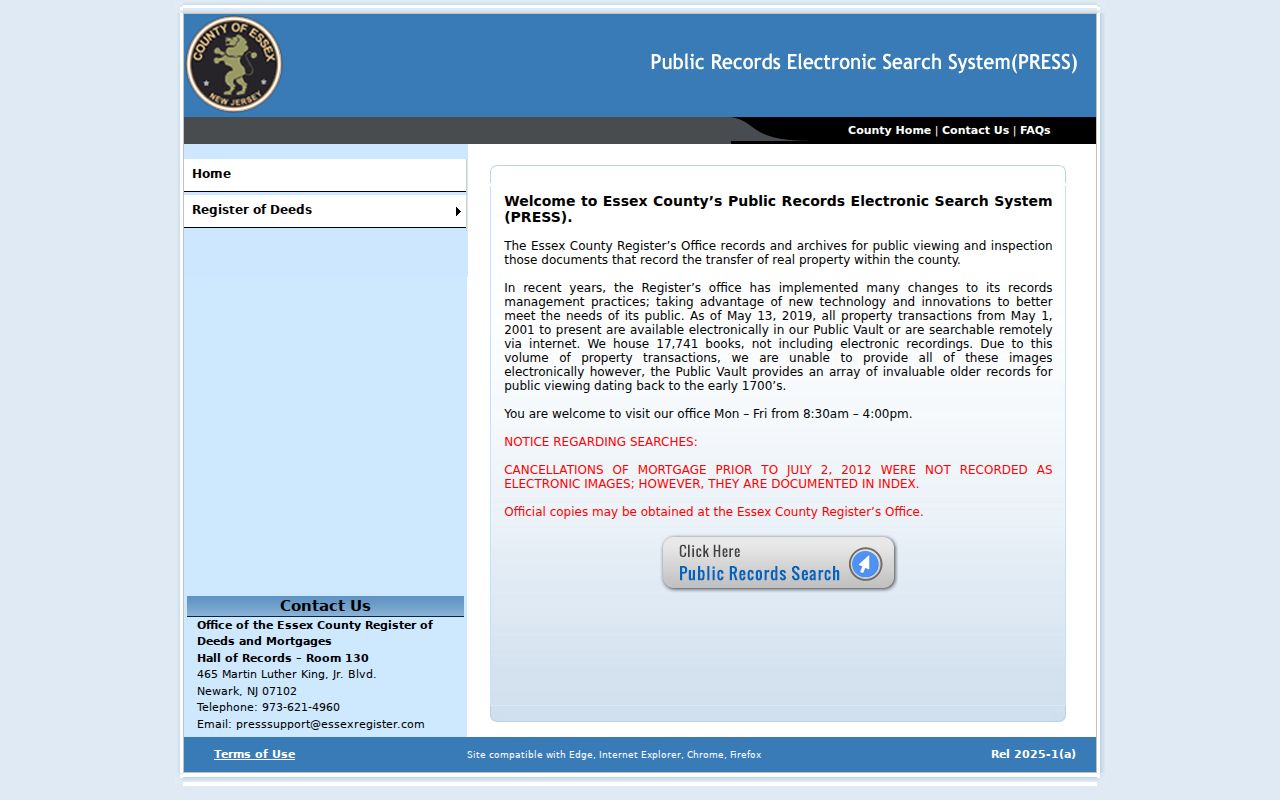
The Register’s public-facing materials establish why a later index result can still require a book, document number, or public-room visit.
Bloomfield Previous Resident Context
Maps and municipal books add period context without naming a complete household. The verified Library of Congress Sanborn item is dated 1950, has a publication range of 1938 through October 1950, and contains 84 sheets. It can show building footprint, use, and street context, but it is not evidence of a person’s residence. Record the printed edition and correction information before comparing it to a deed or directory.
The State Archives finding aid identifies nine Bloomfield ledgers and day books from 1812-1899. Those volumes form an early municipal paper layer, not a searchable resident list. The Township’s 1865 historical map also predates later municipal separations, so an older record labeled Bloomfield can refer to a larger historical geography than today’s Township.
Keep the unit of each source visible in the research notes: a ledger entry, printed street line, book/page, census household, SBL, or web result. A directory year is a publication date, a census records one enumeration date, and a deed recording can follow its execution. Those differences can explain why an address appears in one Bloomfield source but not another without forcing a conclusion about a person’s movements.
Bloomfield Previous Residents Limits
Use address history for family research, estate questions, and understanding a building’s past. Do not turn an old address into a claim about a living person’s current location. A missing online result may reflect a spelling variant, a record cutoff, a missing image, a protected address, or a record that exists only in a book or archival collection. Keep source dates beside each note and return to the named custodian for the underlying record.
Lawful use. Bloomfield previous-resident research is for house history, family history, and personal curiosity. Do not use public records to monitor, harass, intimidate, or harm anyone.